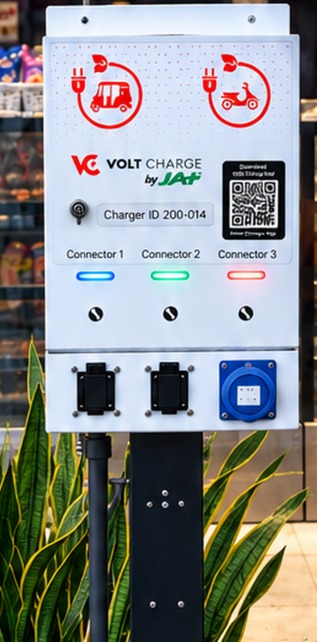

Volt Charge Hosts Islandwide Installer Technical Training, Certifying 40+ Partners
September 25, 2026

A persistent concern about the rapid growth of electric vehicles in Sri Lanka is what it will do to the national grid. The fear — that tens of thousands of EVs charging simultaneously will overwhelm the Ceylon Electricity Board's infrastructure — is understandable. But actual charging data tells a very different story.
Analysis of real-world usage patterns from the Volt Charge network shows that observed EV demand is a fraction of what worst-case theoretical models project. Utilisation rates on Volt Charge fast chargers run at 10–20%, not the near-100% that simultaneous-peak scenarios assume. When that real-world behaviour is scaled across the national fleet, the 72-hour interpolated demand peak from Volt Charge network data comes to just 3.13 MW — a number that puts the grid-overload narrative in perspective.
Estimates of EV grid impact commonly cite figures as high as 300 MW of additional peak demand during the 6–10 p.m. evening peak. Those figures typically assume the entire registered EV fleet is charging at the same time. In practice, charging is spread across the day and across different charge point types, and the composition of Sri Lanka's EV fleet skews strongly toward lower-draw vehicles.
JB Securities data for 2025 EV registrations shows the picture clearly: two-wheelers account for 33,177 units — the dominant segment by far — against 3,457 SUVs and 2,982 motor cars. A two-wheeler draws a fraction of the energy a passenger car does on each charge cycle. When realistic fleet-mix assumptions replace the worst-case, even modelled high-simultaneity scenarios land far below the figures being cited in policy discussions:
| Simultaneity assumption | Modelled grid demand |
|---|---|
| 50% charging at once | ~80 MW |
| 70% charging at once | ~115 MW |
| 100% charging at once | ~165 MW |
Even the maximum theoretical scenario — every registered EV charging simultaneously — produces a figure well below the 300 MW commonly quoted, and far below the kind of concurrent simultaneity that the data show ever actually occurs.
Beyond the demand question, EVs carry the potential to actively stabilise the grid rather than stress it. Because charging is flexible — unlike, say, an industrial motor that must run when production demands — EV batteries can absorb surplus electricity during periods of high solar generation in the middle of the day, smoothing the duck curve that high renewable penetration creates.
Sri Lanka's recently introduced time-of-use electricity tariff structures create the pricing signals that make this work in practice. When charging is cheaper during off-peak hours, EV owners have a direct financial incentive to shift their demand away from the evening peak. Smart charging systems, including those managed through platforms like Volt OS, can automate this entirely, aligning charge sessions with cheap, low-carbon electricity without any action required from the driver.
A separate but equally important dimension of the grid debate is what the electricity is being used for. About 58% of Sri Lanka's electricity currently comes from fossil fuels, according to CEB data. Critics of EV adoption sometimes point to this figure to argue that EVs are simply running on fossil fuel by another route.
The efficiency gap tells a different story. Electric drivetrains convert 60–90% of electrical energy into motion. Internal combustion engines convert 15–30% of fuel energy into motion — the rest is lost as heat. Even drawing from a grid that is majority fossil-fuel-powered, an EV uses significantly less primary energy per kilometre than a petrol or diesel vehicle. And as the renewable share of the grid grows, the carbon intensity of every kilometre driven on electricity falls automatically, with no change required to the vehicle or its charging behaviour.
The conversation in Sri Lanka is shifting — from asking whether the grid can accommodate EVs, to asking how to optimise the relationship between EVs and the grid. That is a more productive question, and the data from networks like Volt Charge's are the foundation on which it can be answered with evidence rather than assumption.
The path forward involves data-led infrastructure planning, tariff structures that align EV charging with grid needs, and continued investment in renewable generation that improves the carbon profile of every unit of electricity delivered. Sri Lanka's EV transition is not a threat to grid stability. Managed well, it is an opportunity to build a more resilient, more efficient energy system.
Source: This article is based on a guest column by Dr. Beshan Kulapala, Co-Founder, Director & CEO of Volt Charge Sri Lanka, originally published in Lanka Business Online. Read the original article on Lanka Business Online →